Open source · Runs on your laptop
Clarity over money.
BlitZave is a free personal finance app that lives on your own laptop. It reads your accounts, sorts your spending, and shows you what you're actually doing with money. Calmly, and without keeping score.
Lives on your laptop
Everything stays in one SQLite file in your home folder. Copy it, back it up, take it with you.
Read-only, always
Your bank connects through your own SimpleFIN account. It can see; it can never move money.
Nothing phones home
The app answers only on 127.0.0.1. The one network call is your bank sync. An update check, and Claude for Goose, stay off unless you turn them on. No analytics, ever.
Free and open
Apache-2.0, built in the open. BlitZave itself costs nothing, today and for good.
An ally, never a scorekeeper
Most money apps keep score. BlitZave has your back.
It reports what happened and leaves the judgment out. No red numbers for spending, no streaks to break, no guilt.
Streak broken. You missed your goal.
Rough month. Happens. Your three-month average is still up.
You overspent on dining again.
Dining ran higher this month. Want to see what shifted?
(Silence, or a hollow badge.)
Your no-spend mornings held. That's $180 toward your emergency fund.
In BlitZave, red means something actually broke, like a sync that didn't finish. Never a number you didn't like.
Calm on top, power underneath
Everything you need. Nothing shouting.
A sparse surface by default, with the full detail one tap down whenever you want to look closer.
Home
One thing worth knowing
BlitZave opens on one sentence, inside a ring that shows how far through the month you are. A goal passed halfway? Savings went first? A heavier start? It says the one that matters, and leaves the rest one tap down.
- Wins first; a heavier month gets context, not a warning
- Milestones at 25, 50, 75 and 100%, in words
The week a goal passes halfway
Japan trip: halfway there.
$4,644.10 of $8,500.00 is set aside. At $500.00 a month, the rest is there around June 2027.
When savings moved before the spending
You're in good shape.
Savings went first this month, $1,100.00 on the 1st, and spending is right where it usually is.
After a big charge early in the month
A heavier start. That happens.
Most of it is one $640.00 charge on the 3rd. Your three-month average hasn't moved.
Goose
Ask about your own money
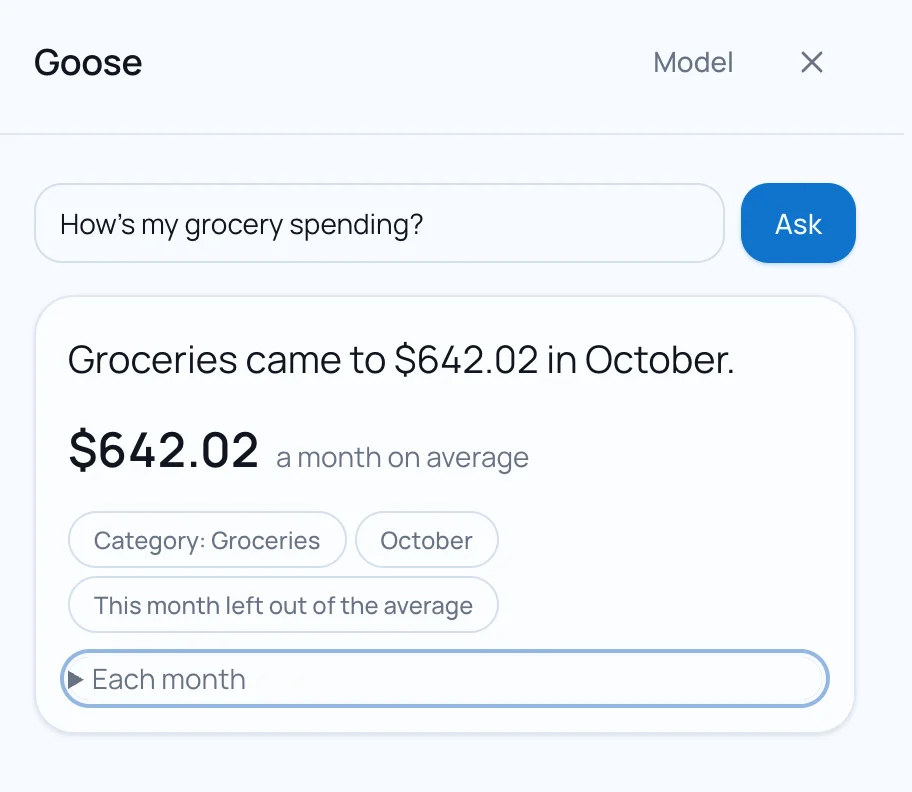
Goose is the ally you can ask. How's your grocery spending going? Tag a trip's purchases? A model turns your words into a plan, and BlitZave runs that plan here on your laptop. The model never sees a transaction, and every number comes from BlitZave's own math.
- A model on your laptop through Ollama, or Claude if you opt in
- Every answer shows how it read your question
- Nothing changes until you press Apply, and Undo takes it back
Savings
Goals with a home
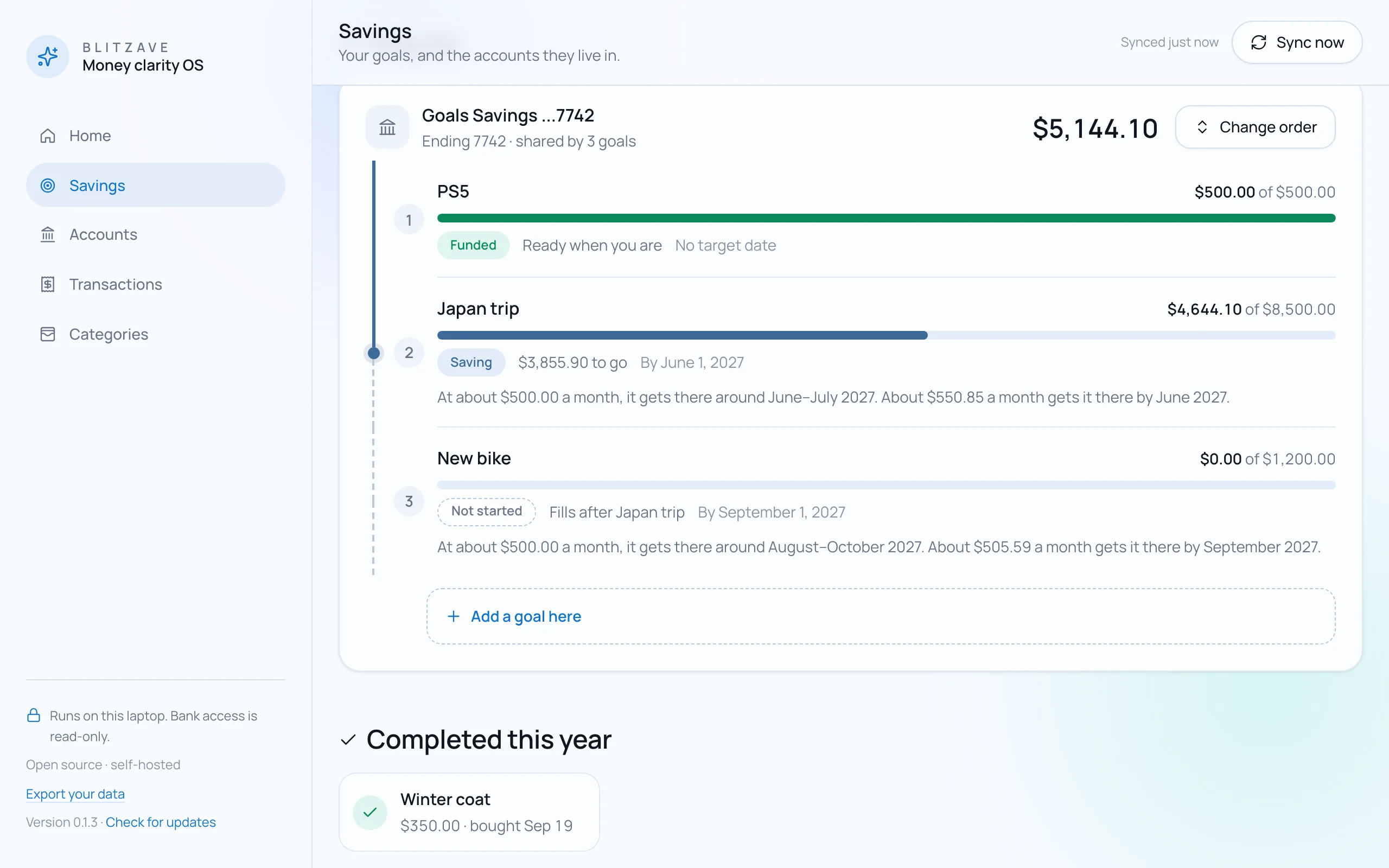
Each goal lives in a real savings account, so its progress is that account's balance. An emergency fund gets an account to itself; a trip and a new phone can share one, filling from the top in the order you choose.
- When it gets there, as a range of months at your pace
- Money left the account? It asks once: was that the PS5?
Transactions
One calm month at a time
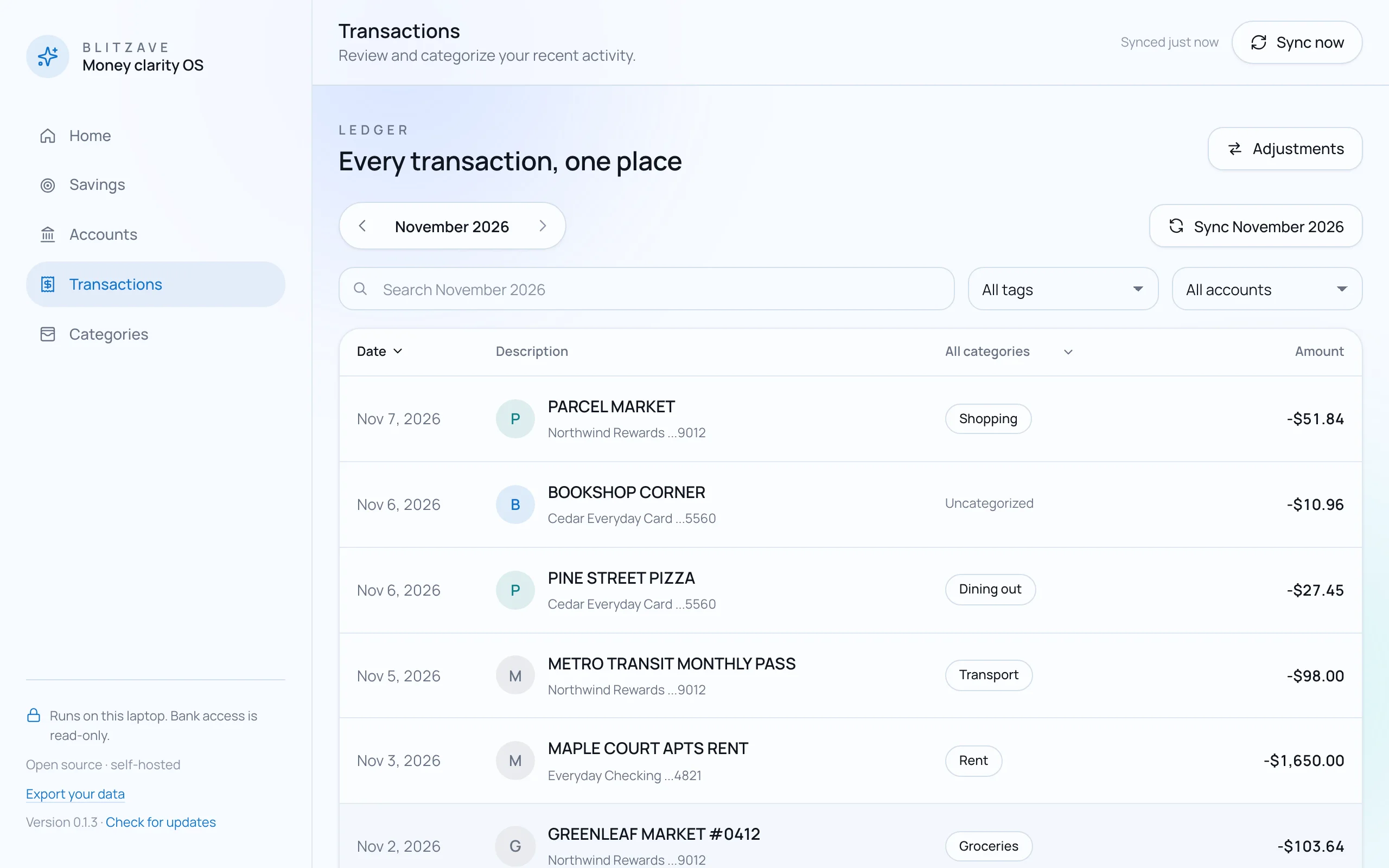
Every account, every transaction, a month per page. Search, filter, and re-sync any single month from your bank with one click.
- Checking, savings and credit cards together
- Splits and tags when one category isn't enough
Rules
Teach it once
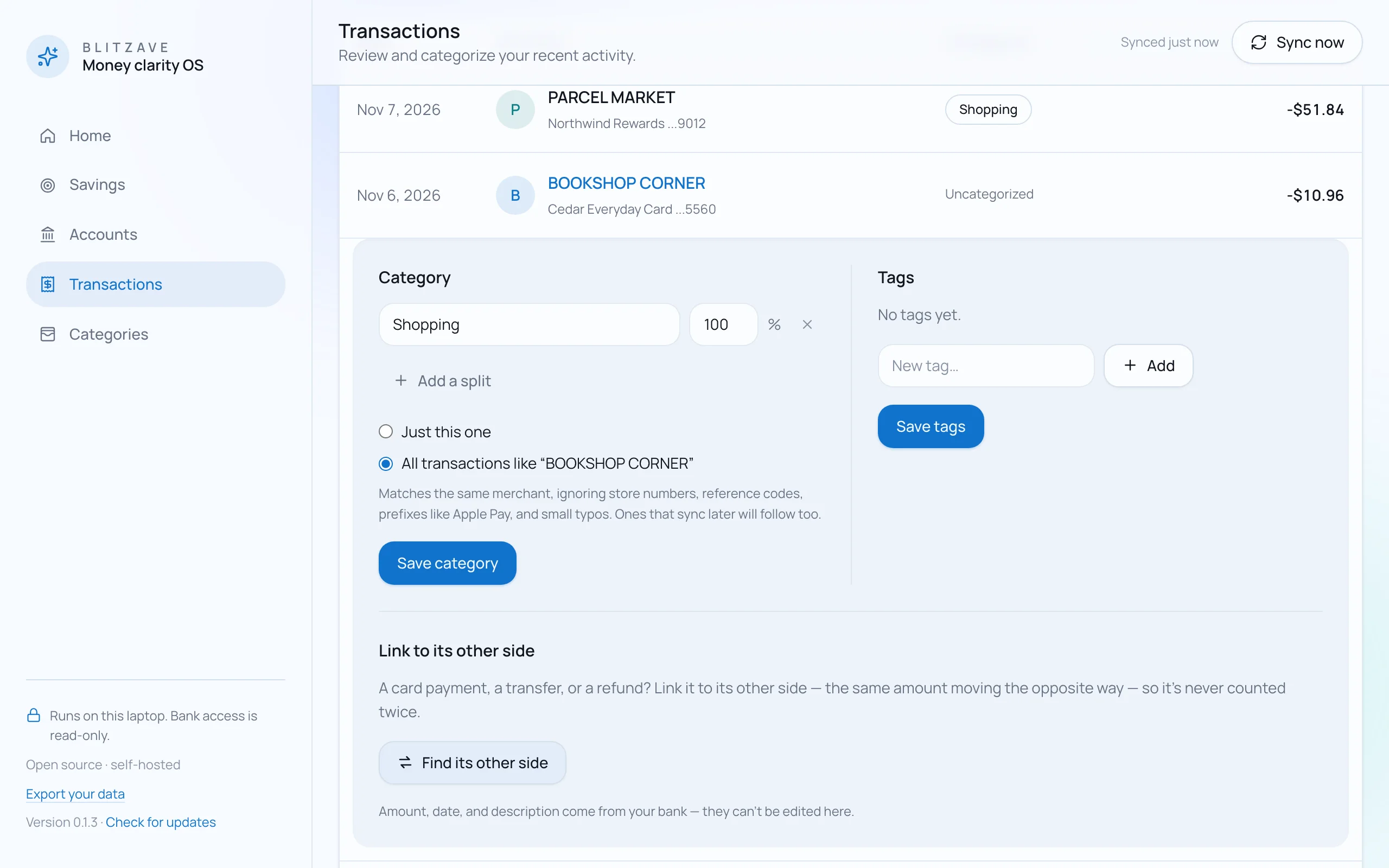
Categorize a purchase and choose "all transactions like this." BlitZave matches the merchant through store numbers, wallet prefixes and small typos, and every future sync follows.
- Your own corrections always win
- The bank's record is never rewritten
Budgets
Context, not alarms
A budget can cover a month, or every 2, 3, 4, 6 or 12 months for gifts and insurance. A marker shows how much of the round has passed, the pace is told in plain words, and each closed round says how it ended. Going over is information, not a failure state.
Budgets, step by step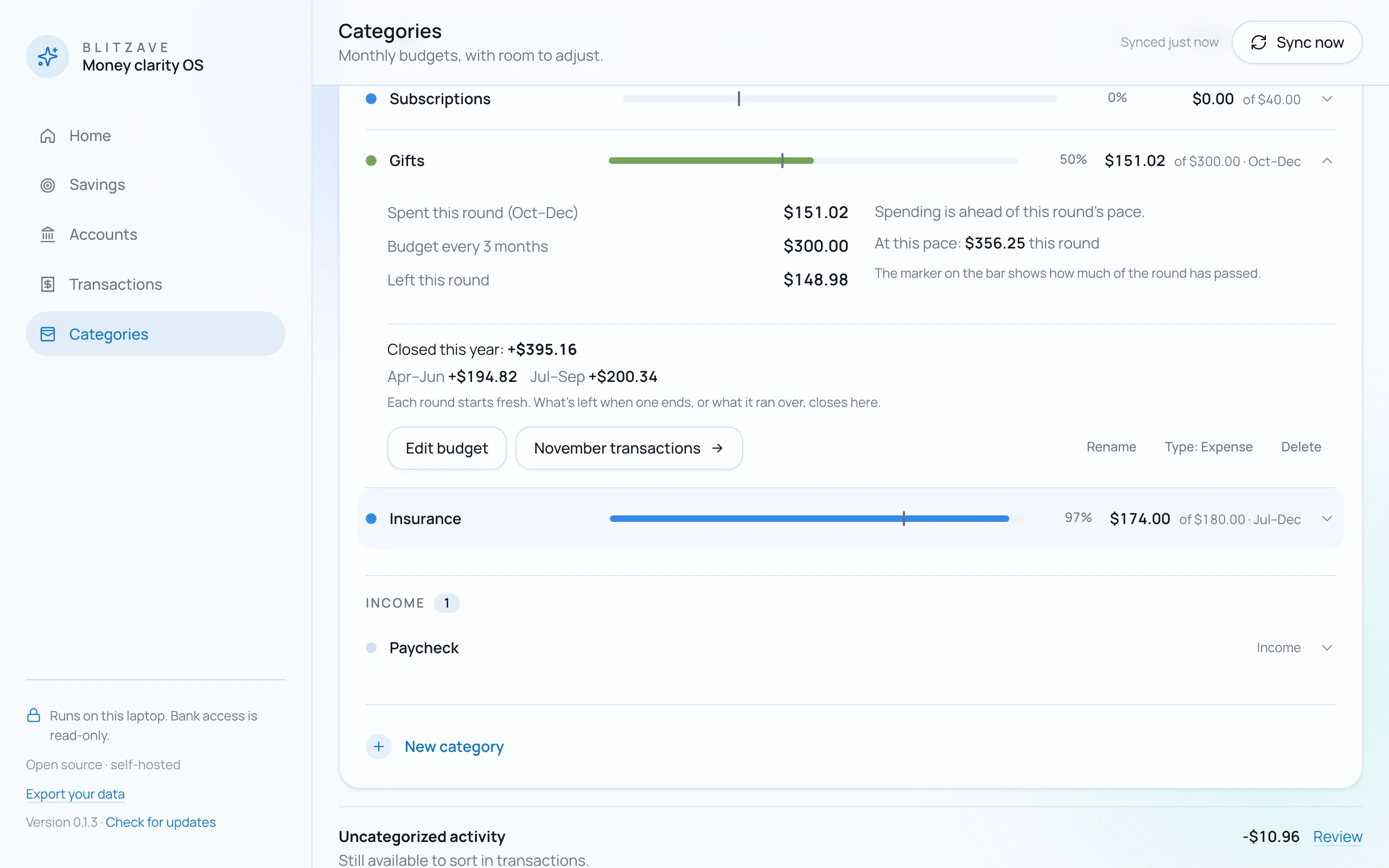
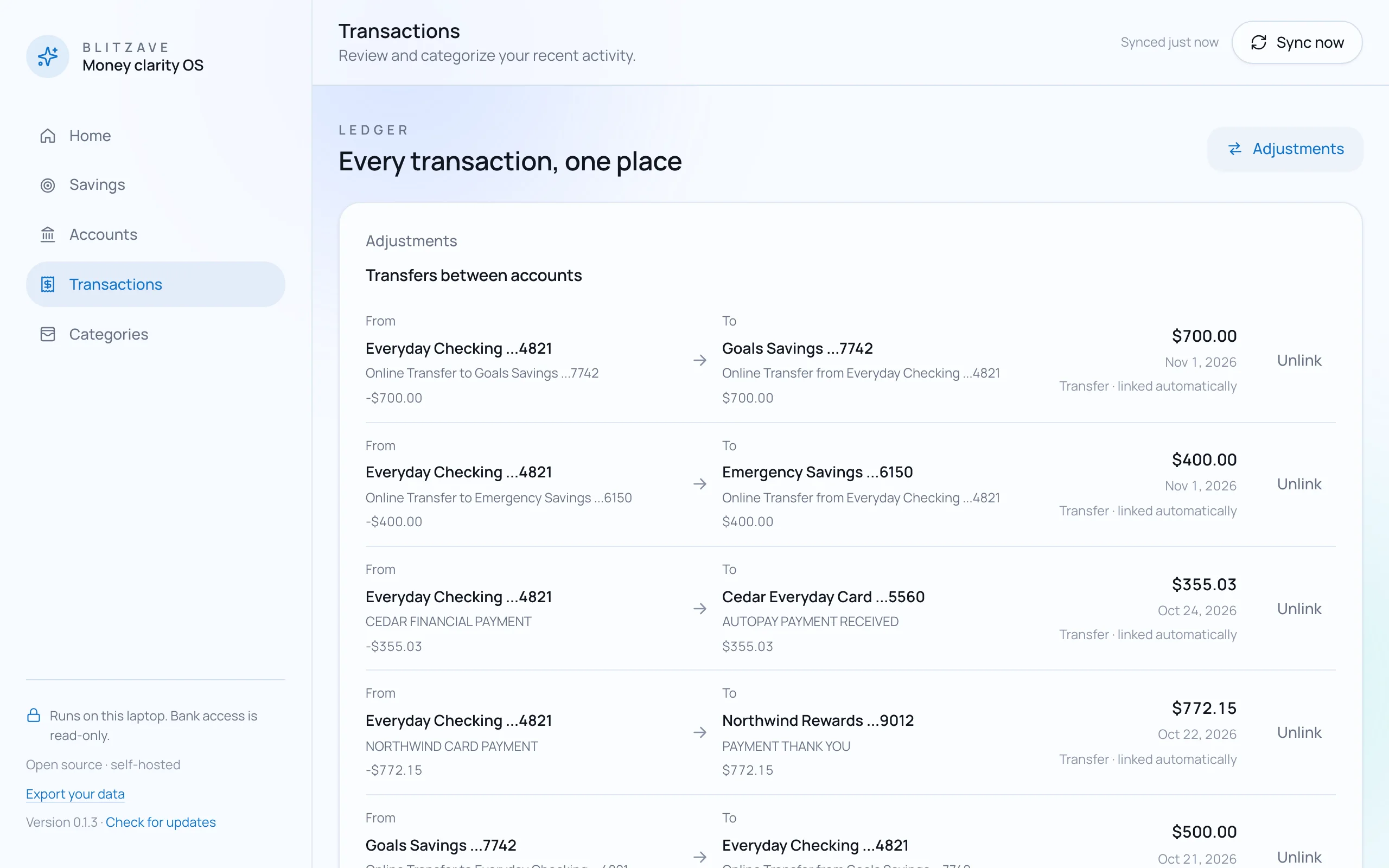
Adjustments
Every dollar counted once
Card payments, transfers between your accounts, and refunds are linked on every sync, so they never count as spending. Link anything else by hand, unlink anything that's wrong, and every balance still reconciles.
Get started
Running in a few minutes.
Try it on made-up data first. When you're ready, one install and one token. That's the whole setup.
-
1
Install uv
uv runs Python projects, and installs Python 3.12 for you if you need it.
curl -LsSf https://astral.sh/uv/install.sh | sh -
2
Try it first
Before you commit, one line runs BlitZave on a made-up household, Goose included. No bank, no SimpleFIN, nothing kept. Ctrl + C deletes it all.
uvx --from git+https://github.com/blitzave/blitzave blitzave --demo -
3
Install, and connect once
Like it? Install, choose connect your bank at the top, and paste a setup token from SimpleFIN Bridge. Your last 90 days arrive. New to SimpleFIN? Here's how to get a token.
uv tool install git+https://github.com/blitzave/blitzave
blitzave
The demo needs only uv. Your own money needs a SimpleFIN Bridge account (a small subscription, paid to SimpleFIN). It runs on macOS, Windows and Linux.
Install, SimpleFIN, accounts, budgets, goals and Home, one short chapter each.
What's next
The Vital Five.
A few behaviors drive most financial outcomes. BlitZave is learning to notice five of them, and reflect each back as one calm sentence tied to a goal you chose.
- 01 Live
Pay yourself first
Did savings move before the spending did?
- 02
Lifestyle creep
Is spending quietly rising as income rises?
- 03
Mindful or impulse
The gap between planned and reactive spending.
- 04
Consistency
Steady beats strict. Are expenses even, or spiky?
- 05 Live
Goal trajectory
At this pace, when does the goal actually land?
Two are live today and drive Home. The other three are next. Follow along, or help build them.

Built in the open, for everyone.
Bring a question, an idea, or a bank that won't sync. We'd love to meet you.